
Introduction
Tangle is the current protocol (EVM-based; legacy: Tangle Substrate) for building and running decentralized services secured by restaked assets.
Developers publish composable services called Blueprints. Users instantiate Blueprint-based services on demand. Operators run those services, and restakers supply the economic security backing them.
Historical note: earlier iterations of the Tangle network included Substrate-native components and UX (e.g., Polkadot.js flows). Substrate-specific pages should be treated as legacy unless explicitly labeled otherwise.
Build Composable Service: Blueprints are composable services that can be instantiated by users. They are built using the Blueprint SDK: https://github.com/tangle-network/blueprint/tree/v2
Earn as a Service Operator Operators can earn rewards by operating Blueprint instances requested by users. Operators can register for Blueprints and maintain control over the services they operate, selecting the assets they want to expose for securing the Blueprint.
Maximize Asset Utilization Tangle enables shared security across Blueprints, allowing operators to secure multiple Blueprints with a single set of assets and restakers to earn rewards for their stakes proportional to the value secured.
How Services Work
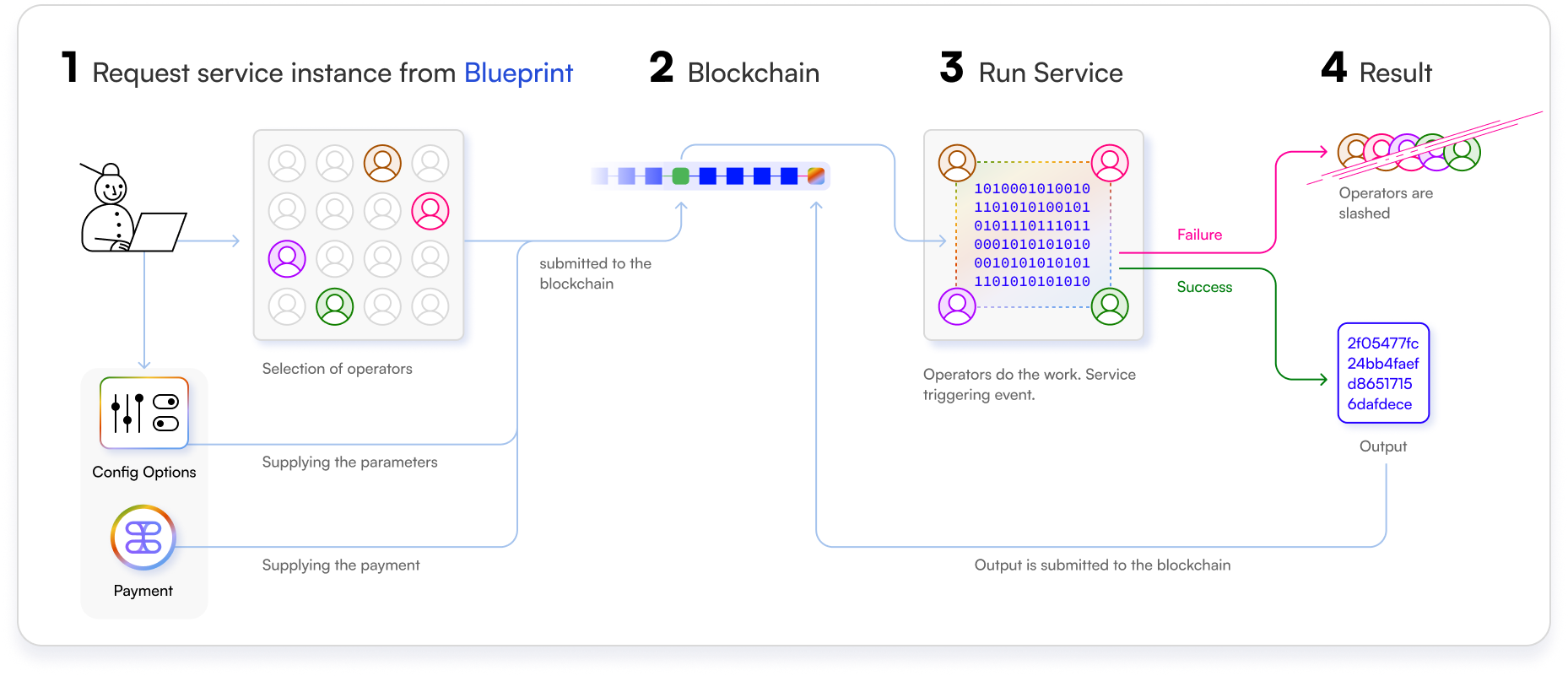
Tangle employs a modular architecture to enable the creation and deployment of complex cryptographic services called Blueprints:
Blueprints
A Blueprint is an on-chain definition that describes how an off-chain service behaves (jobs + schemas + sources + metadata). A Blueprint is not a live service instance; users create services from blueprints by selecting operators and paying fees. Read more about Blueprints
Restaking on Blueprints
Asset issuers restake their assets on operators who run services based on Blueprints. Asset issuers can restake any fungible asset and can restake these assets on a single operator at a time. Operators register for services and agree through the smart contract logic to run Blueprint service instances when requested. Read more about restaking
Requesting Service Instances
Users deploy live service instances using a Blueprint’s request functionality. The requester specifies any criteria like the number of operators or other operator attributes. A specific subset of restaked operators is then selected to run that service instance.
We aim to support fine-grained controls over requesting instances, such as specifying the number of operators, the operator set, and other operator attributes. This allows users to customize their service instances based on their requirements.
Incentives
Operators earn service fees for running services and may earn TNT incentives funded by explicit budgets. Developers can earn a share of service fees and, depending on configuration, may be eligible for incentive programs tied to usage and performance.
This separation into Blueprints and instances allows services to be defined once but instantiated multiple times by different users with varying operator requirements. Blueprint developers benefit from their work being utilized widely across ecosystems and applications.
Use Cases
Tangle is designed to function as a highly-specialized crypto cloud platform. It is meant to support a wide range of complex cryptographic services and applications built by developers in a reusable and instanceable fashion. Some key service areas include:
-
Privacy Infrastructure: Tangle provides a foundation for enabling privacy-preserving solutions through technologies like multi-party computation (MPC) and zero-knowledge proofs.
-
Oracles: Build decentralized oracle services that can securely feed off-chain data to blockchains using Tangle’s threshold signatures and MPC primitives.
-
AI/ML: Offer secure and scalable AI inference, fine-tuning, and proving through actively validated services on Tangle’s decentralized network.
-
Custody Solutions: Leverage Tangle’s cryptographic services to create distributed custody solutions with robust security guarantees.
-
Bridges: Develop cross-chain bridges and asset movement solutions using Tangle’s MPC co-processors and private bridging capabilities.
-
Zero-Knowledge Services: Implement applications leveraging zero-knowledge proofs, such as zero-knowledge machine learning (ZKML) projects, using Tangle’s proof generation services.
-
Novel Cryptographic Applications: Tangle’s modular architecture and rich cryptographic library enable developers to build innovative applications requiring advanced cryptographic primitives.
The core vision of Tangle is to provide a comprehensive infrastructure for developers to create and monetize a wide array of cutting-edge services secured by the network’s novel restaking mechanism. Developers are incentivized to contribute valuable service blueprints, which can then be instantiated and utilized across ecosystems by operators staking assets from various networks.